

A Strengths-Based Path to Meaningful Work
By Bill Beachy
In the past year I had the opportunity to be a guest on The Thoughtful Talents podcast with Jen Werner and Chad Ahern. I was invited to speak on strengths-based entrepreneurship. At the beginning of the podcast I was asked to define an entrepreneur. I don’t know if I had ever set out to provide a personal definition but at that moment this is what I said. “Being an entrepreneur is so much more than starting a business or chasing profit. It’s about passion – recognizing opportunities and generating creative ways to live out one’s passion.”
As I look back, I recognize that my definition has, in some measure, reframed entrepreneurship from a narrow hustle into a deeply human vocational calling. Entrepreneurship is not just about commerce and creating a bottom line, I believe it is also about calling. When an entrepreneur’s calling is pursued through the lens of strengths, it becomes a practical, resilient, purposeful way to build a life that matters.
From Country Roads to Cash Flow
My backstory begins on rural roads in central Ohio farmland born into a family with limited means. My dad was a tenant farmer, which means we did not own the land, but farmed it for the Landlord. We milked cows, raised calves, planted soybeans, corn and wheat seeking to scratch out a living. We had an extensive garden and raised our own beef and pork. I had two pairs of pants and two shirts for school (purchased through the Sears and Roebuck catalog) wearing them on alternate days…they were pretty ragged by the end of the school year. I remember at the end of the calendar year just after I turned 10 years old, we had a family meeting where it was proudly announced that we made more money that year than ever before…$1,500.
There was very little that I needed but there were some things I wanted, and I had an alert eye for opportunity. As a kid, 6th grade, I became a Burpee seed salesman, pedaling door to door on my Western Flyer bike up and down the country roads, knocking on doors and pitching my product in order to generate funds to pay for the bike itself. The nickels, dimes and quarters did not add up to much, certainly not enough to buy a bicycle. One neighbor hired me to help tear down broken front porch, mow the yard and trim shrubs. I worked all day, and the neighbor paid me with a $5 dollar bill, my first. It was big money in those days, and I felt an enormous sense of pride. Not necessarily in the money earned, but in the fact that I had something to offer that added value to someone.
My tendency at that time was to go after every task with little thought about potential dangers. While pulling, tugging and jerking to get the boards off the broken porch we were tearing down on that day, I tripped, fell and sat on a nail sticking up on another board. I had to go to the doctor’s office for a tetanus shot and it cost $5.
I did chores around the farm we lived on and worked with my dad to cut and split wood to sell from downed trees to expand the acreage for our crops. The size of a cord of wood was 4’x4’x8’ which we delivered and stacked for $15. While I did not receive financial remuneration from all of my efforts, it helped me develop an approach to my chores where I would envision the work to be done, develop a plan to complete it and then implement my plan.
During the spring of my 8th grade year, we left the farm and went into the restaurant business. I was the official dishwasher beginning at .50 cents an hour. By high school, I was helping run a pizza takeout and delivery operation at the restaurant in addition to working nights at a manufacturing plant as a janitor, and by age fifteen I’d saved enough money to buy and restore a ten-year-old car. I still have my account book, marking the years it took to realize the incremental increase in my savings.
After high school I entered college and spent several very unproductive years at a state university and (un)ceremoniously invited by the Dean to find another institution of higher learning to pursue my education. In short, I flunked out.
However, I eventually found my way, applied myself and completed a bachelor’s degree along with two master’s degrees and a Ph.D. During the pursuit of my education my pattern continued – I sought to stack lawful micro-ventures to fund my education and thus my vision.
In graduate school, I made pizzas in my kitchen and sold them out of the window of my apartment to serve a campus with no pizza shop. I worked for minimum wage in the tech department for the university. In addition, I formed a nonprofit organization to support my musical endeavors.
During that time, I would travel around the country on the weekends to perform concerts, preach revivals and provide music for youth camps. People began to ask for copies of the music I had written and performed so I invested in writing, performing, producing and recording two record albums, which was a huge supplement to the income I received from performances. In addition, I developed branded merchandise in the form of T-shirts and baseball caps. I could hardly keep up with the demand. At the sales table following the concerts I included a signup sheet for contact information so individuals could receive my newsletter and tour information. In those days, there was no Facebook, texting, email, Instagram or X. Everything was old school…phone calls and snail mail.
I found that a larger vehicle was needed in which to travel and carry sound equipment, guitars and piano. I sent out an appeal to various individuals who attended the concerts and purchased records and merchandise and invited them to invest in the work I was doing. I developed a brochure lining out the vision, the venues in which I performed, the need for safety and comfort during my travels, along with some testimonials from people around the country. The response was amazing. I purchased a new Chevy Cargo Van and did some updates to it for travel. It was paid for in less than a year due to the gracious supporters as well as my hard work.
I never had the intention of seeking to “make it big.” Rather, my desire was to bring a message to the listener and seek to make a difference in their lives, however large or small. When I completed my first master’s degree, my kids came along, and I decided to step back from all the travel. It had been a great four years that included one year full-time and three years part-time while I was in school. I learned a lot and developed many lifelong relationships.
However, my education was not yet complete and after three years I applied and was accepted into a Ph.D. program at Duquesne University and moved my family to Pittsburg. I knew it was going to be difficult, and I had no idea how I was going to fund the program. I had several ideas though.
I applied for grants, scholarships, teaching fellowships and made an appeal to those individuals with whom I had built relationships with over the years. During my years in the doctoral program my days consisted of rising at 5 am, taking the 45-minute train ride into Pittsburgh, going to class, returning home, fulfilling my duties as a pastor in a small church, studying, being with my family and to bed at 10 pm…repeat. This particular doctoral program was designed to be completed in 5 years with the exception of the dissertation. I knew that the more time it took, the more expensive it would be and the longer I would need to raise funds to help underwrite my education and living expenses. After, my first year, I convinced the faculty to allow me to complete the program in three years. At the conclusion of three years, I completed all of my course work, fulfilled all of the language requirements, passed my comprehensive exams and completed my dissertation proposal. I was exhausted. It then took another two years to write my dissertation.
In a little over 14 years, with help of numerous benefactors, teaching fellowships I secured, grants and scholarships I received, the various jobs I held and the entrepreneurial opportunities I created, we were able to complete one bachelor’s degree, two master’s degrees and a Ph.D. borrowing only $2,500. Granted, education was less expensive in those days, and salaries lower. In hindsight, I believe I used an innate formula. However, it was only upon reflection that I was able to better understand and thus systematize my approach:
- I saw a need: necessary income stream to pay bills and the completion of my education. What was the motivation…I wanted to make a difference and have an impact in the lives of people.
- I crafted a scrappy, brazen solution: side hustles, jobs, music gigs, fund raising, scholarships, grants, fellowships.
- I executed the solution: I developed an overarching plan to accomplish the goal, one step at a time resulting in a cumulative overall effect.
- This systemized solution was repeated as needed.
These successes weren’t one-off stunts. They were rehearsals in opportunity recognition, disciplined execution, and resourceful reinvention – exactly the muscles I believe entrepreneurs need for the long haul.
The Strengths Behind the Story
I didn’t have CliftonStrengths® language during those years, but looking back, I can see how my Top 5 themes drove my strategies, tactics and plans for implementation. My Top 5
- Strategic – Choosing the smartest route and adapting mid-course as needed.
- Ideation – Generating options to create income and impact (always legal).
- Activator – Turning a plan into motion – fast.
- Maximizer – Refining and elevating results over time.
- Futuristic – Anticipating the end of a job or season and planning what’s next.
My supporting themes of the 34 total discovered by Gallup are – Relator, Learner, Arranger, Intellection, Input, Self-Assurance, Positivity, Achiever. These themes help to explain more of my innate design: my appetite for study, ability to weave people, need, vision and objectives together, reflective problem-solving, confidence under pressure, and a steady, unrelenting persistence to finish.
The point isn’t that everyone needs these exact themes. It’s that your strengths are your personal operating system. Discover them, embrace them, work with them by design and intention and you’ll get compound returns. Work against them and you’ll fizzle and burn out. A person cannot become something that they are not designed to be. Yes, we can make some inroads into those areas where we are weaker or less effective. However, according to Gallup research, 70% of one’s thinking and functioning during the day is through the effective utilization of their Top 5 Strengths. Since that is the case why turn attention to our weaknesses? Preferred outcomes and the fulfillment of objectives whether quantitative or qualitative can be realized through the use of our Top 5 strengths by design.
“You may not create the next technological phenomenon or become wealthy – but that’s not the point.“
Strengths-Based Entrepreneurship, Broadly Defined
Culture tends to cast entrepreneurship as starting a venture, raising capital, scaling fast, and landing on magazine covers. I prefer to widen the frame:
- You might never build the next tech giant.
- You might never get rich.
- For me, that’s not the point.
The point for me is to live according to my design, lean into what is “right” about me and align my life with who I am and what I value – because that’s where meaning, peace, purpose and sustainability is experienced.
Sometimes that may be through a company you have formed, or a side hustle you have created or a program you have developed that is scalable.Sometimes it’s intrapreneurship – building something new within your organization. Ultimately, the work is the same: discover your design, spot real needs you can address, and design practical paths to serve.
“Entrepreneurship is positioning yourself to live your passion by design, not drift.“
First Step: Know Yourself. Next Step: Know Your Team.
It has to begin with knowing oneself; my mantra is simple and relentless: Know yourself.
- Study your strengths and motivations.
- Grow your emotional intelligence: How do you perceive yourself? Express yourself? Live out your best self on a daily basis? Manage stress or conflict? Make decisions. Relate to others and the world around you?
- Stay a student of your own patterns of behavior: what fuels you, what drains you, where do you predictably stumble?
Then become a student of your team. Learn their strengths, passions, wheelhouse and sweet spots. Match their roles to their wiring. Coach others for meaning and momentum along with raising your capacity as well as influence as a leader. Research from Gallup indicates a large share (70%) of employee engagement is tied to how a Team leader, leads. Whether the exact percentage shifts over time, the principle holds: leaders profoundly shape the climate in the workplace, in the organization, in the board, in the venture, in the dream.
This isn’t accidental work. It is not a way of leading into which one stumbles or trips. It requires intention: time to think, vision, the humility to be wrong, the courage to listen, and a settled security in who you are.
Fire–Aim–Ready (And Making Peace with It)
I sometimes joke about the fact of my “fire–aim–ready” approach to life. This tendency has frequently gotten me in trouble – while at the same time, it has also propelled me forward.
I have come to believe that this propensity, while it can be viewed and experienced as reckless and rash if overdone, is part of the intrinsic splendor of who I am at my core.
The lesson in this isn’t to sand off every sharp edge; rather, it’s to embrace your wiring and learn to manage it. If you’re an activator, build checkpoints. If you’re deliberative, set decision deadlines. The goal isn’t to become someone else; it’s to become the most meaningful version of you.
For New Leaders in Entrepreneurial Settings
New leaders in scrappy contexts face a tricky balance: doing the internal, reflective efforts while coaching others to become their best self while they do the work. This is some of what I have learned:
- Start with self-awareness. Clarify your strengths, limits, triggers, and energy rhythms. Create space for rest, reflection and renewal. Have the disposition to life and world that includes healthy and appropriate transparency and vulnerability.
- Map your team. Who does what best? Where does each team member come alive? This does not happen only through observation, it involves interaction, conversations, and coaching moments.
- Design on purpose. Don’t stumble, drift or trip into your actions. Make role decisions and processes that reinforce the use of strengths in action. Have the humility to have a second thought and willingness to be wrong.
- Do the “have-to’s”. (I know the “get to’s are much more stimulating and exciting.) Early stages require standing in the gap. Whether it is a new venture, team building, redevelopment of your organization or reimagining your vision and mission, role your sleeves up and do what’s necessary to reach the next level.
- Build the bridge. As you grow, replace “I am the bridge” with a bridge others can cross – systems, processes, people.
Start with a practical playbook
1) Audit your story.
List 5 moments (any timeframe) when you solve a real problem. For each:
- Which of your Top 5 strengths did you use?
- What pattern shows up (need → idea → plan → action → refinement)? Identify your personal patterns.
- What today rhymes with that moment?
2) Name your calling.
Draft a one-sentence personal “foundational life calling,” your “why you exist statement” a vision for your existence. Example: “I create practical pathways that help people and teams find clarity, grow, and thrive.” Use this as your compass for yes/no decisions when you develop your plan of action.
I wrote mine many years ago: “I am created/designed to make a difference or an impact in the lives of people.” This is not stated with arrogance or pride, it is what drives me, whether I am at the checkout counter at the grocery store or providing leadership development with a C-Suite or state government officials.
3) Run an opportunity flywheel. (Jim Collins – Good to Great)
- Identify three unmet needs you see in your context and think about how you can create opportunity.
- Brainstorm 10 ways to serve each through the following: (messy is fine, sometimes welcomed).
- Creating momentum
- Delivery of value
- Building trust
- Driving results
- Generating referrals
- Reinvesting in growth
- Identify the most compelling need that fulfills your personal vision (not the easiest, most profitable, or viable).
- Decide
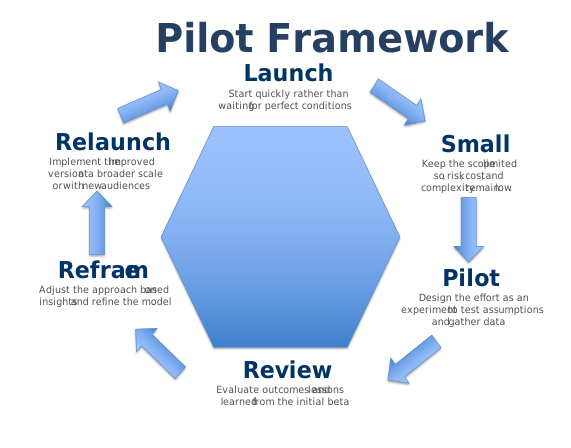
- Launch – start quick as opposed to waiting for perfection.
- Small – limited scope so risk and costs remain low.
- Pilot – an experiment to test assumptions and provide quantitative data.
- Review – consider the success of the beta experiment.
- Reframe – adjust the approach based on insights, then prepare for a broader rollout.
- Relaunch – implement the improved version at a broader scale or with new audiences.
4) Think like a Maximizer.
Weekly, ask: What worked? What didn’t? What should I change? What should I stop?
5) Coach your bench.
- Discover the strengths of your team, your stakeholders, your board, your support circle.
- Put every teammate’s top strengths on a one-page map.
- Seek to discover a stretch role aligned to those strengths.
- Celebrate specific, strengths-based wins publicly.
- Provide sincere, solid recognition for the individuals on your team.
Why It Matters
The model or framework encourages:
- Speed – Don’t get stuck in planning paralysis. Move fast to test.
- Practicality – Do something real (not just theoretical) that produces feedback.
- Risk Management – Keep it compliant and small enough to fail safely.
- Learning Loop – The goal isn’t a polished final product – it’s to collect data, refine, and improve.
Over time, this creates compounding momentum: each opportunity you pursue makes it easier to generate the next.
Wrap up: The quiet ambition of strengths
My story is not a tale of instant scale; it’s a study in sustainable persistence, the kind that stacks small wins, seasons of learning, and resilient habits. It’s a posture you can adopt regardless of industry or job title:
- Know yourself deeply.
- Serve your context with purpose.
- Shape the future with intention.
Whether you’re biking country roads with seed packets, selling pizza from a window to fund tuition, or architecting a leadership program for a modern organization, the work is the same.
Recognize opportunity. Act with intention. Refine with courage.
And keep playing to your strengths – because the path to meaningful impact is paved with the ways you’re already designed to thrive.
If this article resonated with you or your team, Beachy Group would welcome a conversation about strengths-based leadership, entrepreneurship, and building thriving teams through greater self-awareness and intentional growth.
To learn more connect with us to continue the conversation.
About the author:
Bill Beachy is a leadership consultant and founder of Beachy Group. He works with organizations and leaders to build strengths-based cultures that help people thrive through intentional growth and clarity.